
Sourdough Brioche
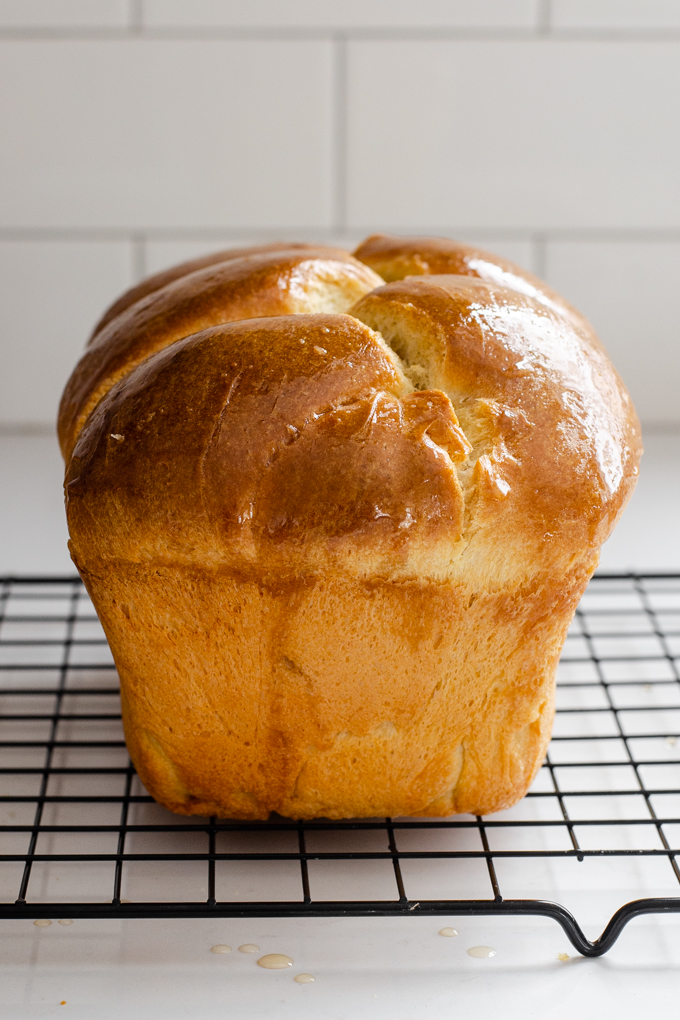
This Sourdough Brioche recipe is simple (only 7 ingredients required!), and only uses natural yeasts, but results in a pillowy soft and delectable loaf!
Y'all.
This is about my favorite sourdough recipe that I've created so far.
It's been a long time coming, but today I'm going to show you exactly how to make this divine loaf of sourdough brioche without any commercial yeast!
But first, let's go into a little nerdy background info...
Table of Contents:
What is Brioche?
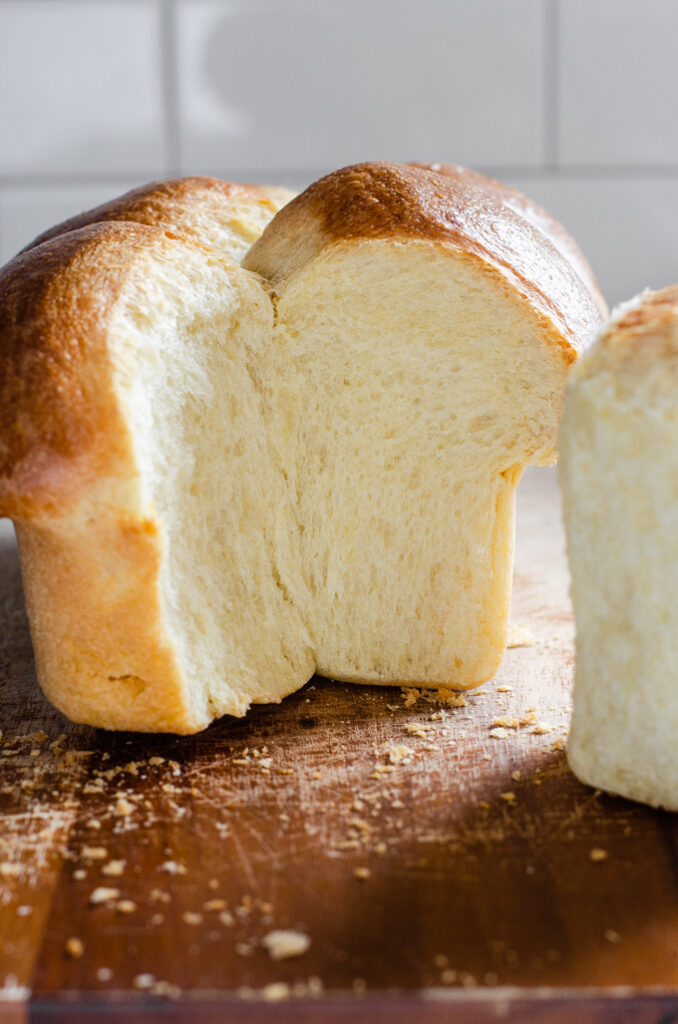
Brioche is an enriched yeasted bread that contains copious amounts of butter and lots of eggs, plus a bit of milk and a smidge of sugar.
It's kind of like a cross between a pastry and a bread, with a tender crumb (from the high butter content), and it is heavenly.
Where Does it Come From?
Brioche is actually in a category of French baked goods known as Viennoiserie, which means "things from Vienna."
But an Austrian military officer brought this style of baked good to France when he opened a bakery in Paris in the 1830s.
So brioche is kind of Austrian, but commonly known as French.
It's a bridge between pâtisserie and boulangerie (styles of French baked goods) if you want to get technical.
How to Pronounce Brioche
As far as I can tell, brioche can be pronounced either "bree-ahsh" (with a short "o" sound) or "bree-ohsh" (with a long "o" sound).
When I've listened to videos of native French speakers, it kind of sounds like a blend of a long and short "o" sound.
Any native French speakers can correct me in the comments!
Is it Sweet?
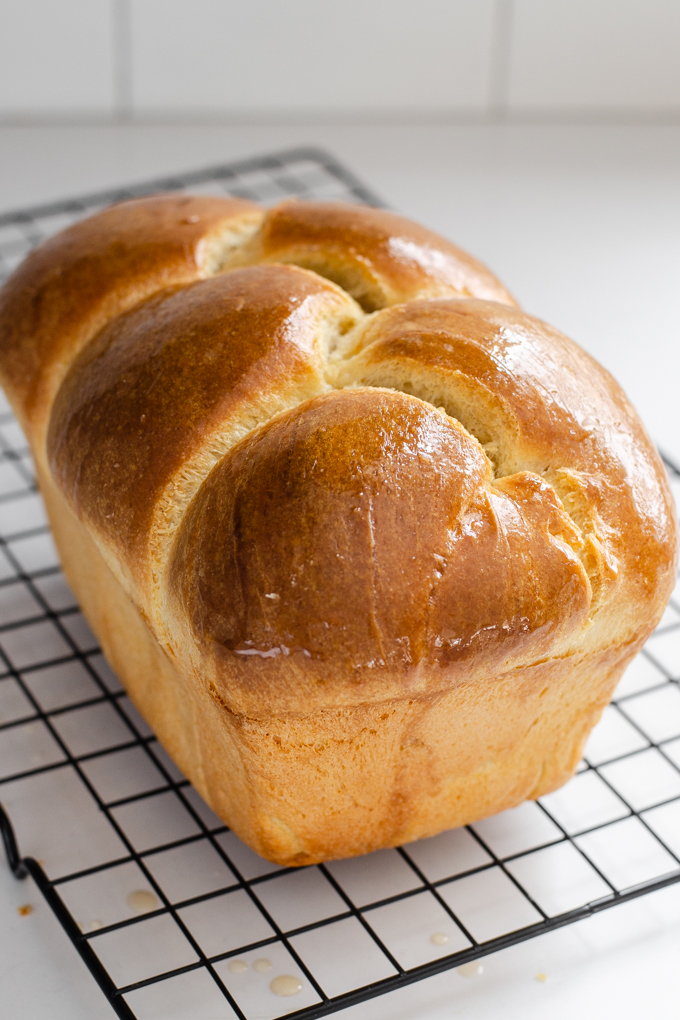
While the dough does contain some sugar, the overall flavor profile isn't really sweet.
You can brush the outside of the baked loaf with a simple syrup (more on that later) to give it an extra hint of sweetness.
Is Sourdough Brioche Bread Healthy?
This is where opinion really comes into play.
I personally think sourdough brioche bread is healthy because the grains are "pre-digested" by the wild yeast.
Also, if you use pastured eggs and grass-fed butter and milk, this can be quite nourishing.
Don't let the amount of butter in the dough scare you off!
Is Challah Bread the Same as Brioche?
No, it's not quite the same. Challah is very similar to brioche, but challah is actually dairy free and brioche definitely is not.
Also, challah is of Jewish origin, whereas brioche is considered French.
How to Make Sourdough Brioche Bread
Okay, let's dive in and I'll show you how to make it!
Let's talk sourdough starter for a minute.
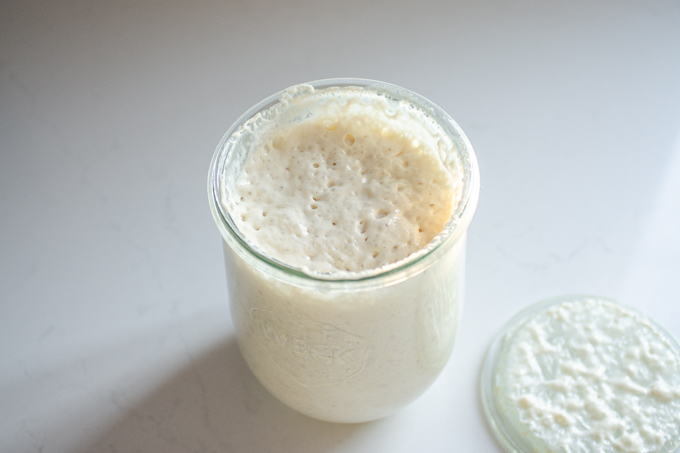
Feed your starter about 8-12 hours before mixing together the dough.
You'll know that your starter is ready to use when it doubles, is active and bubbly, and passes the float test.
To perform the float test, drop a small piece of your starter in a glass of room temperature water. If it floats, it passes!
If you want more of a sour taste, you can use a starter that has fermented longer and smell sour. For a more mild bread, use your starter when it has just reached peak fermentation.
For this recipe you're going to use more starter than you normally would for sourdough bread.
This will help to ensure a high final rise.
Also, since dairy products (e.g. milk and butter) tend to slow down the fermentation process, the extra starter will counteract that.
I have heard of people using sourdough discard to raise bread, but that isn't how I tested this recipe. Basically, you think of making the bread as feeding your non-active starter. However, this would alter the rise time, and could result in a very sour bread.
NOTE: I keep my sourdough starter at 100% hydration, which means that I feed it equal weights, not volumes, of flour and water.
If you're having trouble with your starter, make sure to check out my Sourdough Starter Troubleshooting post!
Mixing the Dough
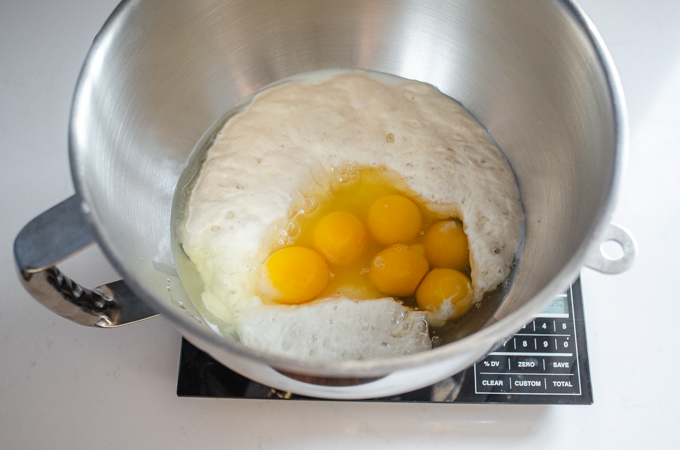
Add the wet ingredients to the bowl first:
Place ⅓ cup whole milk, 2 cups (480 grams) of active sourdough starter, and six eggs in the bowl of a stand mixer.
At this point you might be wondering why you thought putting 6 eggs into a bread dough was a good idea.
Trust.
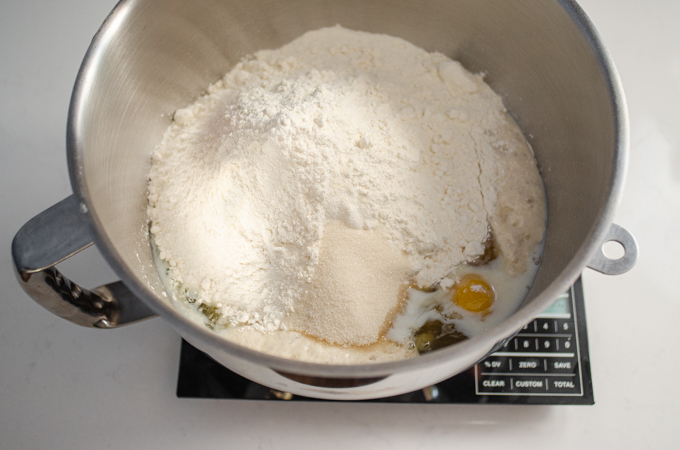
Next, it's time to add the dry ingredients on top!
Add 4 cups (565 grams) of organic all purpose flour and 2 tablespoons (20 grams) of organic cane sugar.
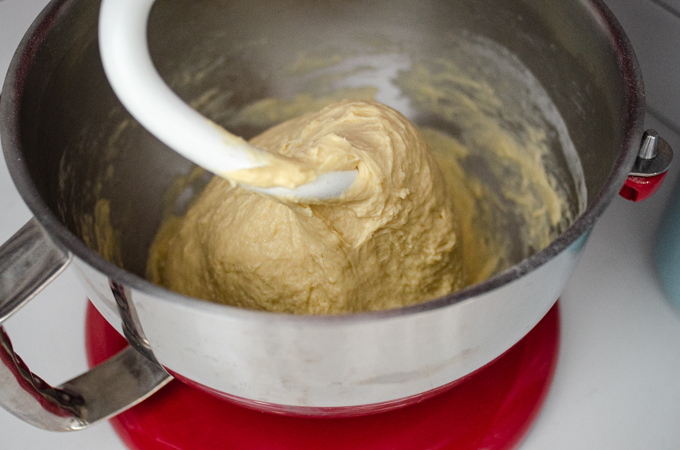
Knead for 5 minutes on medium low speed using the dough hook attachment, just until the dough comes together.
You could also do this with a Danish dough whisk, but why not use the machine and dirty up fewer dishes?
I personally don't let my brioche autolyse, because I haven't felt the need.
But you can always let the dough rest for 30 minutes at this point to give the flour an extra chance to hydrate before adding the salt and butter.
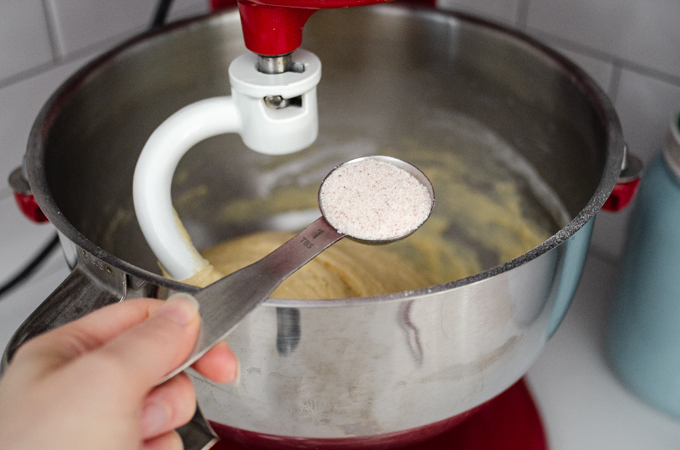
Add 1 tablespoon (11 grams) of unrefined sea salt.
I use Redmond Real Salt for all of my sourdough bakes.
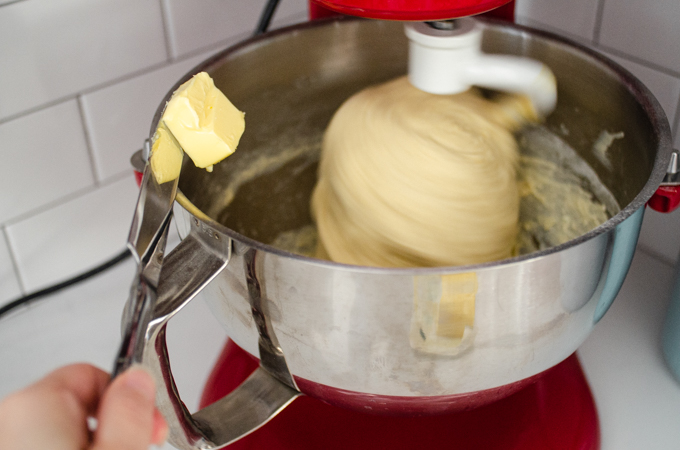
Turn the mixer on and gradually add a cup of softened unsalted butter (yes, this is a RICH dough), one tablespoon at a time.
Don't add the next tablespoon of butter until the previous one is kneaded in.
By the way, make sure your butter is the proper temperature.
You don't want it so soft that it's almost dripping. But you also don't want it so cold that it won't mix in easily.
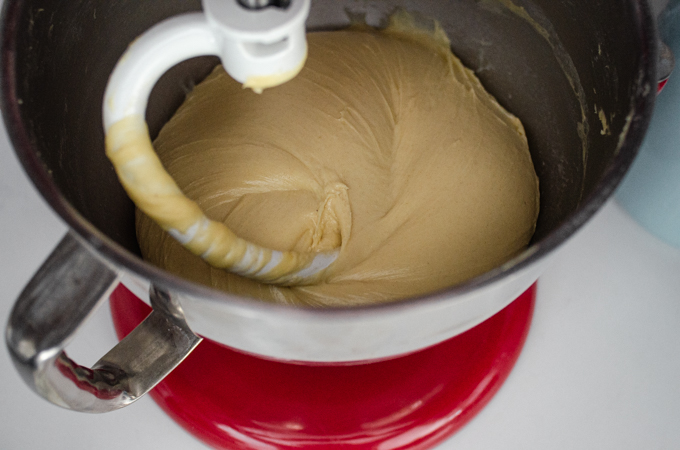
Continue kneading the dough for another 15 minutes after all of the butter is incorporated.
The dough will start to clean the sides of the bowl.
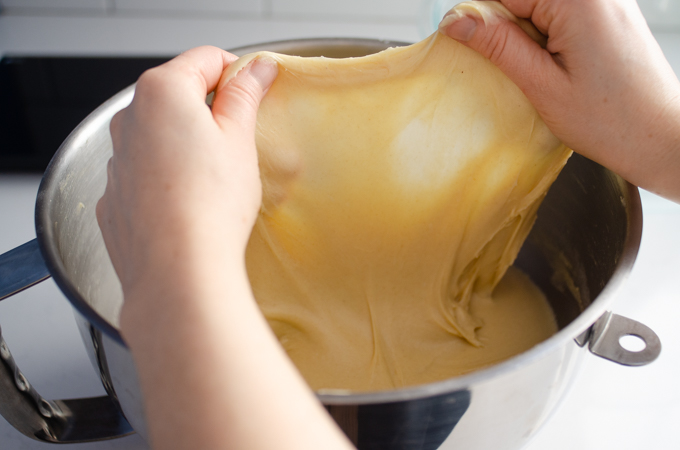
You're looking for the dough to pass the windowpane test.
Stretch it out until you can see light through it.
If the dough breaks and rips apart before you can pull it that thin, it has to be kneaded longer.
Yes, this is a very long knead time. About 25-30 minutes in total. It's needed since this is an enriched dough.
But keep going until you've reached windowpane, or at least very nearly!
I do NOT recommend hand kneading this dough sadly. It could be done, but it would take SO much time.
First Rise (Bulk Fermentation)
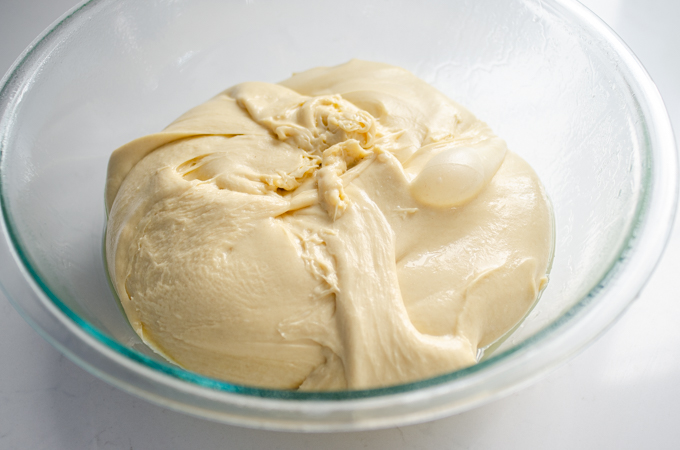
Grease a large lidded bowl and scrape the dough into it.
A bowl scraper would be handy here (I should really purchase one!).
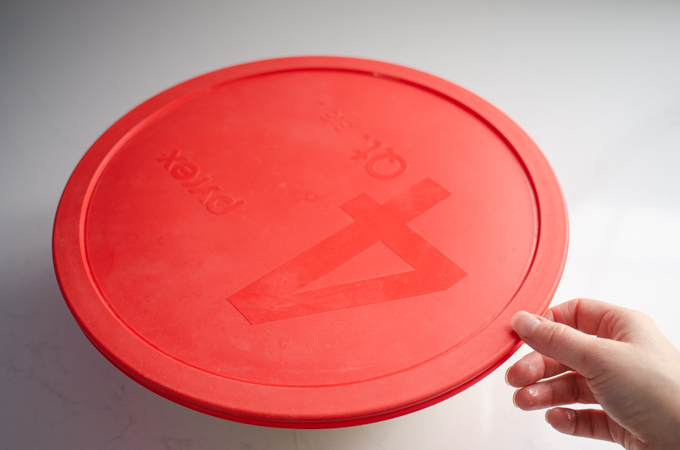
Cover with a lid and let the dough rise and ferment at room temperature for 1 hour.
After that hour, place the dough in the fridge for 12 hours.
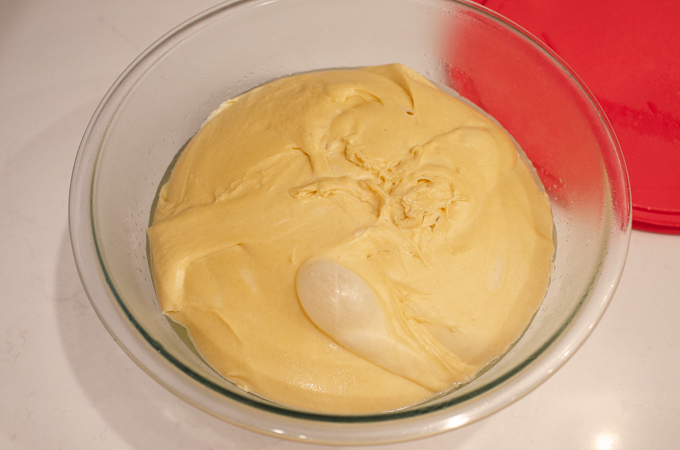
The dough will puff up some, but it won't double during those 12 hours in the fridge.
Forming the Sourdough Brioche Loaves
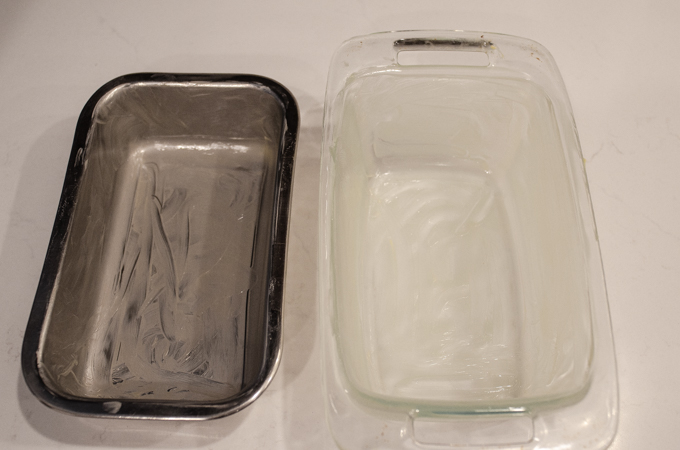
After the initial rise, grease two loaf pans and set them aside.
NOTE: I much prefer my larger Pyrex loaf pan over this smaller stainless steel loaf tin.
The glass tends to brown the bottom of the loaf more readily.
It also releases the baked loaf from the pan more easily.
And it's just a better size for this sourdough brioche loaf.
I should really purchase another one so I don't have to settle for my stainless steel pan!
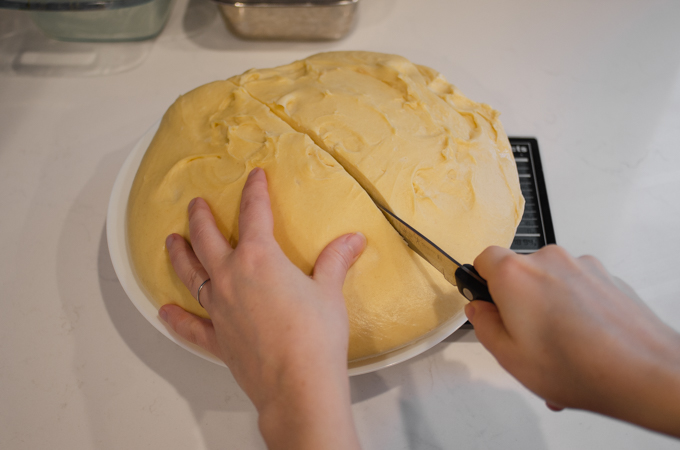
Transfer the dough to a large plate.
Weigh the entire ball of dough (make sure to "tare" with plate first so you don't get that weight as well).
Divide that weight by two, and split the dough in half for the two loaves.
I'm going to show you two ways to form these loaves: braided and bun bread style.
Traditionally brioche is formed into a knot instead of a braid, but this style is more practical for home bakers.
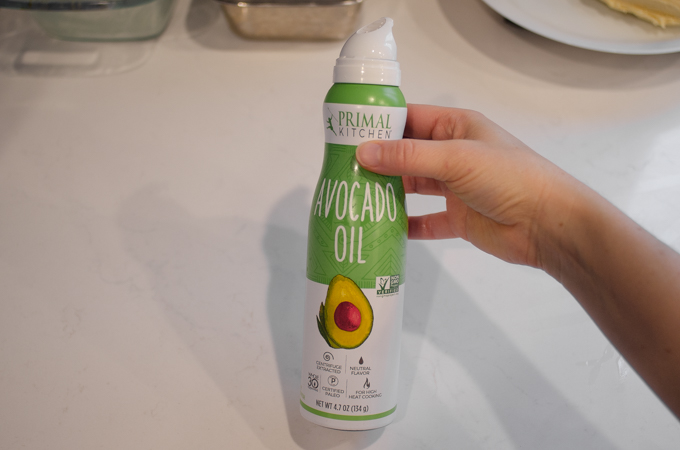
Grease your work surface. This is quite a sticky dough.
You can rub some butter on it, or you can spray it with avocado oil spray.
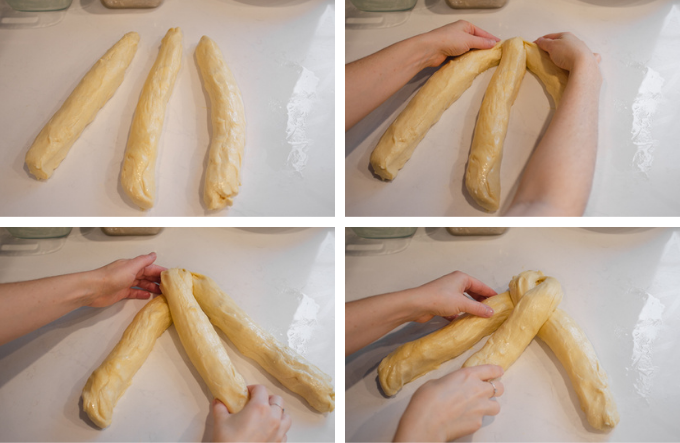
Braided Loaf
Now it's time to divide the dough into three equal pieces.
Divide half of the total weight of the dough into thirds, and weigh out the dough.
For example, if your total dough weight is 1660 grams, half of that would be 830 grams, and a third of that would be 276.66 grams. So each piece should weigh about 276-277 grams.
Am I making sense?
Using greased or wet hands, roll each piece of dough into a log that's 12 inches long and tapered on one end. I find it's easiest to squeeze the dough out with your hands instead of rolling it on the counter.
Pinch the far ends of the dough logs together.
Grab the left log and fold it over into the middle.
Grab the right log and fold it over into the middle.
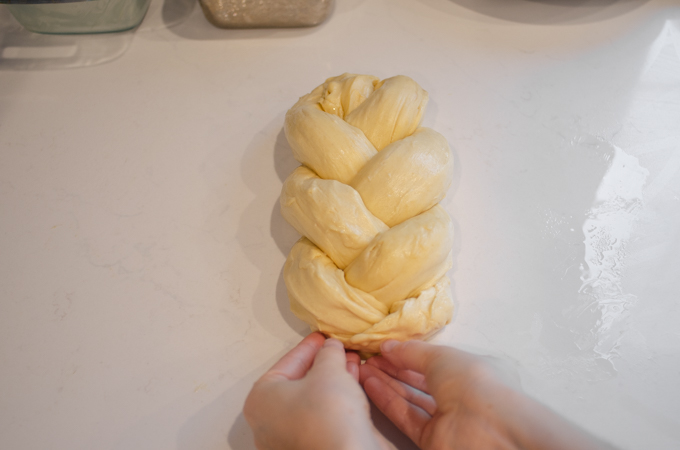
Repeat the braiding process until you get to the end.
Pinch the ends of the logs together to seal.
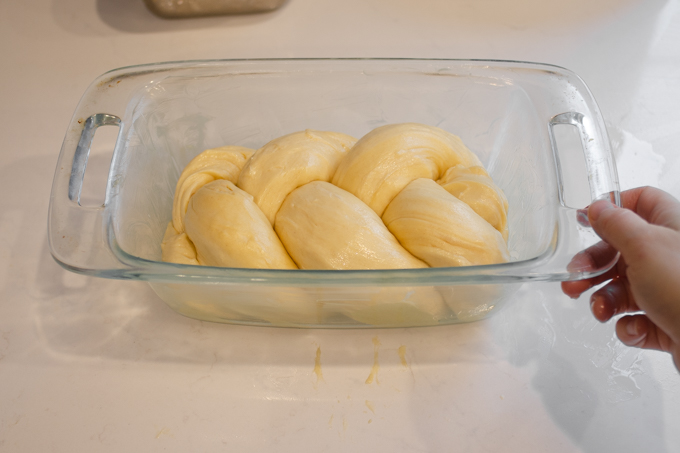
Tuck the braid into the greased loaf pan.
Bun Bread Loaf
Take the weight of half of the entire dough ball and divide it by 6.
Using the same example as before, half of the entire weight would be 830 grams, so each piece of dough should weigh about 138-139 grams (830 divided by 6 equals 138.33).
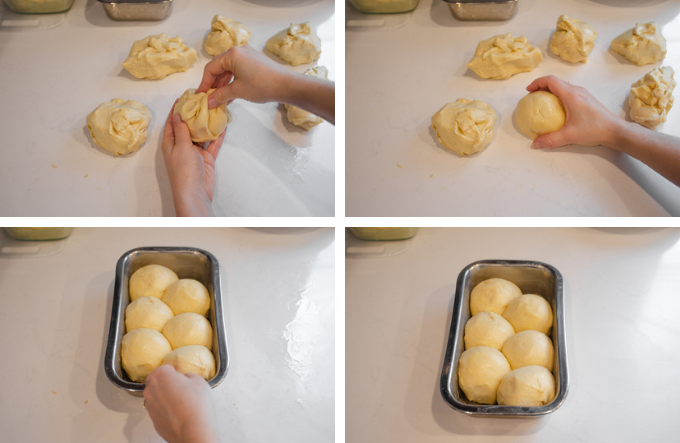
Form each piece of dough into a ball by pinching the ends into the middle and rolling it, seam side down, on the counter.
Watch the video below to see this demonstrated.
Stagger the dough balls in the loaf pan. This creates a neat, almost braided look.
Second Rise
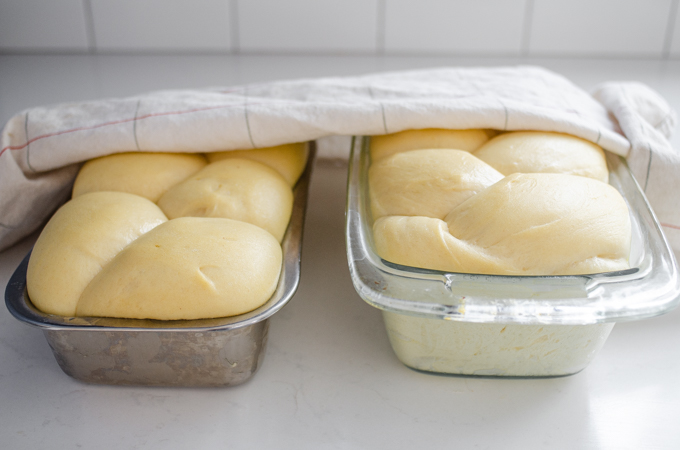
Cover the loaves with a tea towel (you can use greased plastic wrap if you must, but I prefer a tea towel) and allow to rise in a warm spot until they puff up over the sides of the loaf pans.
Since this brioche is risen with sourdough starter, the amount of time it takes to proof adequately varies greatly.
If you have a really warm kitchen, they may puff up in just 2 hours!
Or, if you have a really chilly kitchen, it may take 8 or more hours.
Be patient, and let this sourdough brioche do its thing!
If your kitchen is really cold you may want to cover with a damp towel to prevent the dough from drying out.
Egg Wash
You can achieve that nice, deeply brown, shiny crust that's so iconic to brioche in a couple of ways.
One simple way is to brush the top of the loaves with an egg wash before baking.
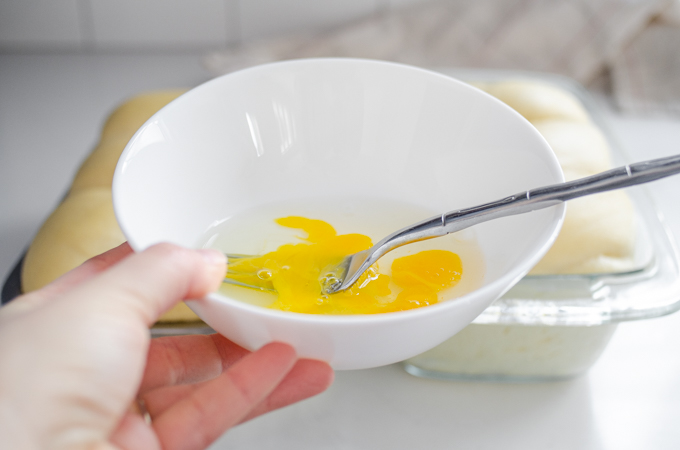
Whisk together one egg and one tablespoon of water until uniform.
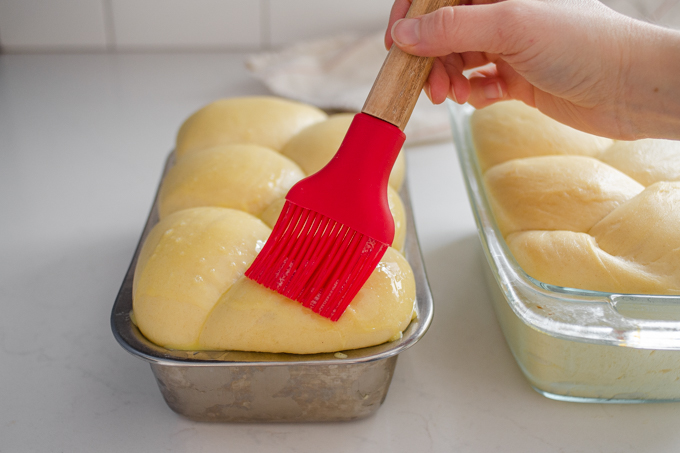
Brush the top of the risen loaf with the egg mixture. Get into all the nooks and crannies!
Baking
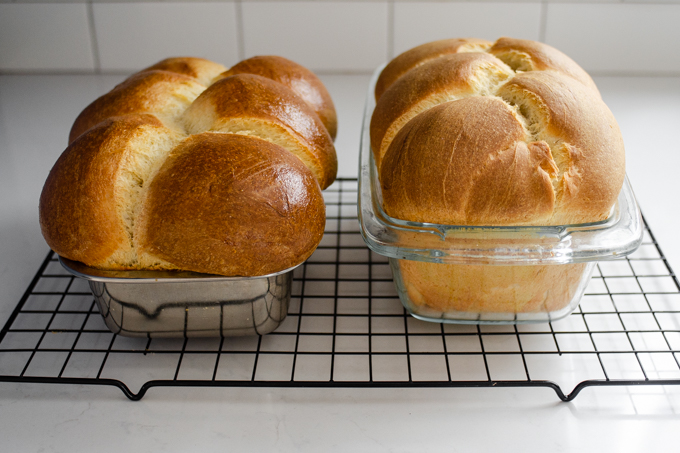
Half an hour before the loaves are done rising, preheat your oven to 375° F (190° C).
Bake the loaves for 35-40 minutes, or until an instant read thermometer inserted in the middle of the loaf registers 190-195° F (88-90° C).
The bake time will vary depending on how hot your oven runs.
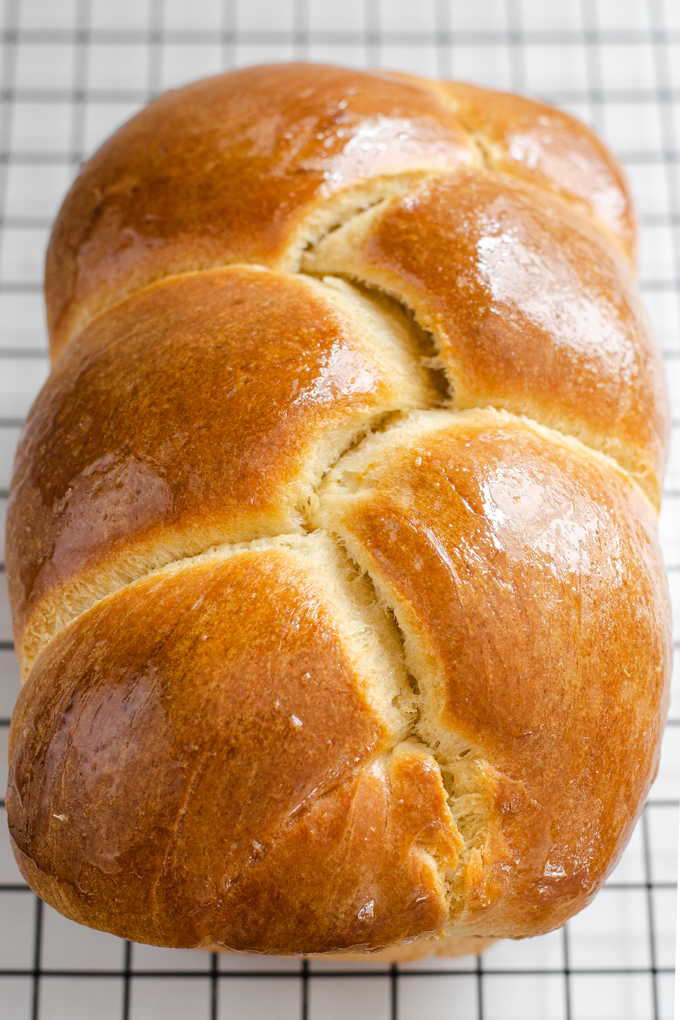
The bread should be deeply golden brown.
Here you can see the difference between the bread baked with an egg wash (left) and the one without (right).
Simple Syrup Wash
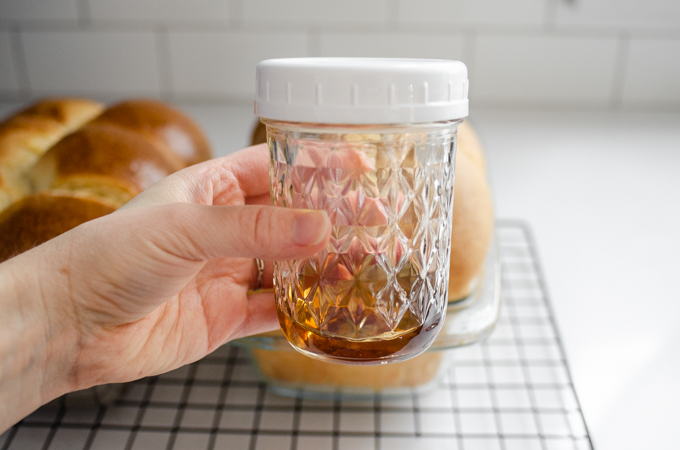
But here's another way you can get that dark, shiny crust: Simple Syrup!
To make a vanilla simple syrup (heavenly on this sourdough brioche!), bring 2 tablespoons of water and 2 tablespoons of sugar to a boil.
Remove from heat and stir in ¼ teaspoon of pure vanilla extra.
Boom. Vanilla simple syrup!
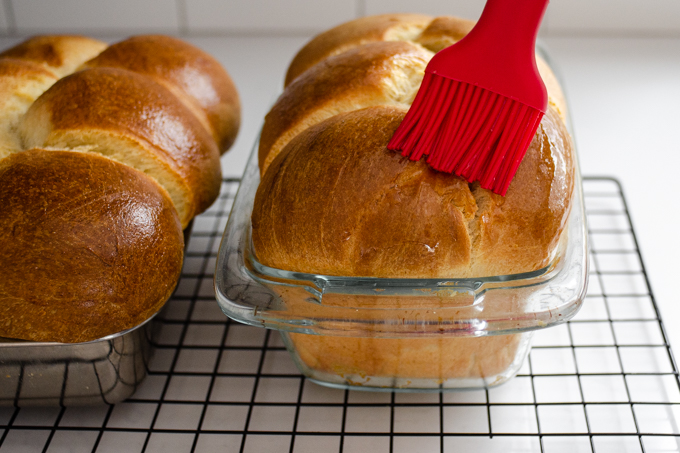
Brush that all over the top of the warm, just-from-the-oven loaf.
It's pretty much the best thing ever.
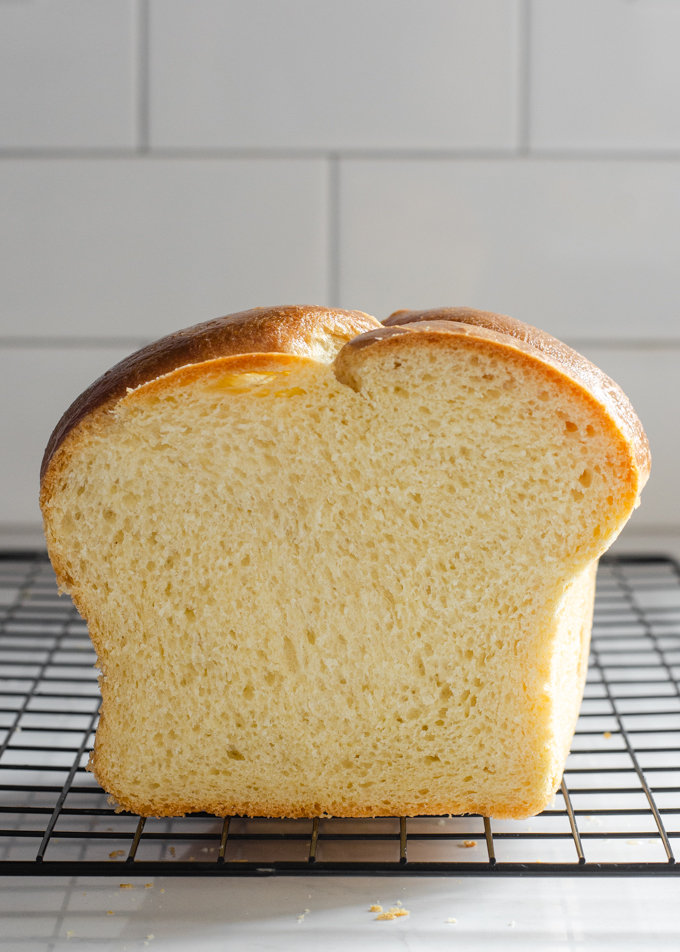
Do your absolute best to wait at least an hour before slicing into this loaf.
It's going to be difficult.
Stay strong!
But when you do finally slice into this sourdough brioche, you'll see why all of that butter and kneading and fermenting were worth it.
So worth it.
How to Eat Sourdough Brioche
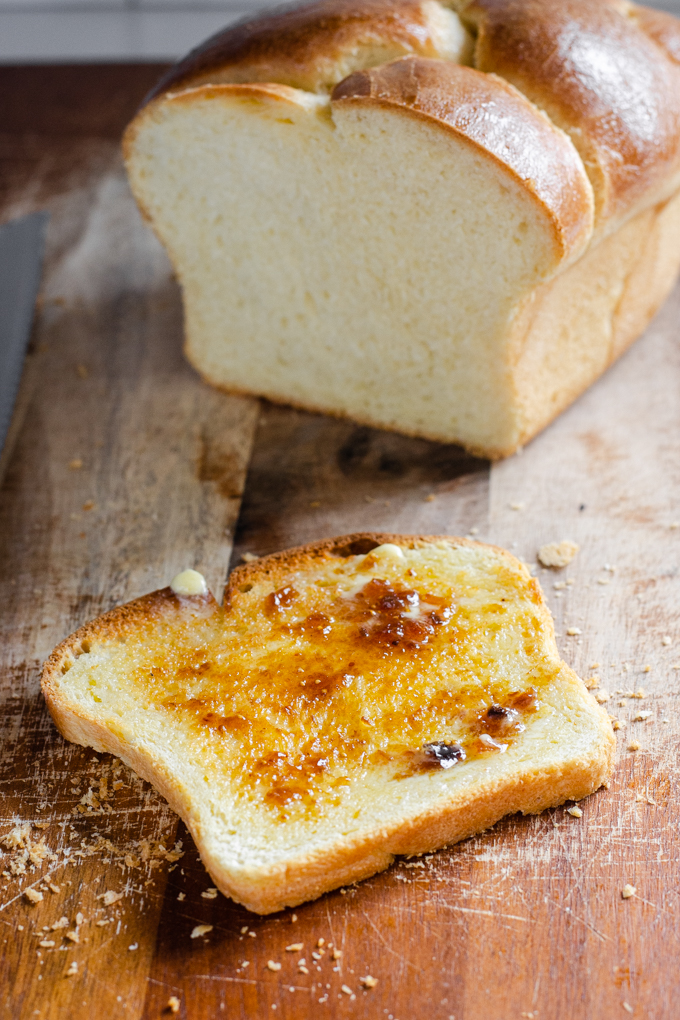
Of course you can simply slice, butter, and eat.
But you're going to die of happiness when you try this toasted with butter and jam.
It's also makes top-notch cinnamon toast: slather it with butter, sprinkle with a little brown sugar and cinnamon, and do a happy, giddy dance after you take your first bite.
Now some people might say that since there's so much butter in the dough, you don't need any on top. To that I say: ridiculous! Butter on top of bread is different than butter in bread.
If you have any leftovers the next day, you can turn it into brioche French toast. It is phenomenal. The soft crumb is perfect.
Leave me a comment and I'll give you my easy (unofficial) French toast recipe!
Sample Baking Schedule
Here is a sample baking schedule that works well for me.
Day One:
11:30 AM: Feed your sourdough starter and set in a warm spot in your kitchen.
7:30 PM: Mix together the dough. Let sit on the counter for 1 hours, then put it in the fridge overnight for 12 hours.
Day Two:
9:00 AM: Form the loaves and allow to rise at room temperature.
1:00 PM (Or whenever they are done rising): Bake loaves. Allow to cool for 1 hour before slicing.
You could feed your starter Friday morning/afternoon, form the loaves Saturday morning, and bake Saturday afternoon! Then you could have it for brunch on Sunday.
Storing:
To store, place the sourdough brioche in an airtight container. You can store at room temperature for up to 1 day, and in the refrigerator for up to 5 days.
For more long-term storage, you can place the cooled loaf in a freezer zipper top bag and place in the freezer for up to a few months.
Do I need to use organic flour?
While not completely necessary, I highly recommend using organic all purpose flour in this recipe.
You want to treat your wild yeast gently, and adding a bunch of pesticides and bleach can adversely affect it.
Can You Make Sourdough Brioche Without Sugar?
Technically yes, but I recommend leaving in the 2 tablespoons of sugar.
That bit of sweetness tends to counterbalance the tang of the sourdough, and it also speeds up fermentation.
BTW, you could form these into hamburger buns as well! Scrumptious!
Video Demonstration:
So that's my sourdough brioche bread recipe! If you're looking for even more sourdough recipe, check out the links below!
More Sourdough Recipes:
- Soft Sourdough French Bread
- Sourdough Pull Apart Rolls
- Soft Sourdough Sandwich Bread
- Overnight Sourdough Waffles
- Pumpkin Sourdough Pull Apart Loaves
- Artisan Sourdough Bread
- Sourdough Banana Bread
- Healthy Whole Wheat Sourdough Sandwich Bread
- Sourdough Pizza Crust
- Sourdough Focaccia Recipe
- Best Sourdough English Muffins Recipe
- Sourdough Hot Cross Buns
Sourdough Brioche
This brioche is made with sourdough starter for healthy fermentation and a bit of tangy flavor!
Ingredients
For the Dough:
- ⅓ cup whole milk (83 grams)
- 2 cups active, unfed sourdough starter (480 grams)
- 6 whole eggs (307 grams)
- 4 cups organic all-purpose flour (565 grams)
- 2 tablespoon organic cane sugar (20 grams)
- 1 tablespoon unrefined sea salt (11 grams)
- 1 cup unsalted butter, softened but still a little firm
For the Egg Wash:
- 1 whole egg
- 1 tablespoon water
Instructions
-
In the bowl of a stand mixer, place the milk, sourdough starter, eggs, flour, and sugar. Knead on medium-low using the dough hook for 5 minutes.
-
With the mixer still running, add the salt.
-
Add the butter, one tablespoon at a time, waiting until the previous tablespoon has been kneaded in before adding the next one.
-
Continue to knead the dough for an additional 15-20 minutes, or until it passes the windowpane test. Grab a piece of the dough and stretch it out. If you can see light through it before it tears, it passes!
-
Scrape the dough into a greased glass bowl. Cover and allow to ferment at room temperature for 1 hour. Place in the refrigerator and allow to chill for 12 hours.
-
Grease two 9x5-inch glass loaf pans. Set aside.
-
Divide the dough in 2 and form each half into a loaf. You can braid the loaves or form them into 6 individual buns. I personally recommend braiding them.
-
Tuck the loaves into the prepared loaf pans. Cover and allow to rise until they puff up over the edges of the pans, about 2-8 hours.
-
30 minutes before the loaves are done rising, preheat your oven to 375° F (190° C).
-
If you'd like to do an egg wash, whisk together the egg and water. Brush on top of the risen loaves.
-
Bake in preheated oven until the loaves are deeply golden and an instant read thermometer inserted in the center registers 190-195°F (88-90°C), about 35-40 minutes.
-
Remove loaves to a wire cooling rack. Cool for at least an hour before slicing.
Recipe Notes
- You can also brush the tops of the loaves with a simple syrup (vanilla is very nice) after they come out of the oven in lieu of an egg wash.
- To make a vanilla simple syrup, simply bring 2 tablespoons of water and 2 tablespoons of sugar to a boil. Remove from heat and stir in ¼ teaspoon vanilla extract.
Updated on 8/3/2022


This looks so good! My starter got a harmful bacteria over the summer so I had to throw it out. I was devastated as it was my back-up starter too. I have not had the chance/time to start up again. This lovely bread may convince me to do so.
Ugh, that must have been frustrating to have your starter go bad! Yes, this brioche is definitely worth the work of getting a starter going again! 😊✨
Thank you so much for this recipe! Do you think I could bake it in a muffin tin, for individual mini loaves? Do you have a recommendation on bake time and temp for such a feat?
Hi, Sandra! I haven't personally tried that, but you should be able to bake them in a muffin tin! I would say grease the tin really well, and bake at 400 degrees F for 15 minutes, and then check for doneness. I should give that a try - sounds delicious!
I made your scrumptious Brioche this weekend and despite the fact that I probably should have let it prove a little longer, it turned out fine. My wife and I did a happy, giddy dance after eating the cinnamon toast and we are looking forward to the french toast for breakfast tomorrow. Thank You for sharing your recipe. I will definitely make it again.
Stay Safe. From Peter in sunny Canberra, Australia.
Aw, so happy that y'all enjoyed it! Isn't the cinnamon toast SO good?! Hope you enjoyed the French toast, too! And I have to admit, I'm a bit jealous of your weather RN - it's sunny hear, but so so cold.
I run a B & B in Fredericksburg, Texas and I made your Brioche Bread about two weeks ago and then made my stuffed French Toast with Blueberry Compote the next day and my guests were happy, happy, happy. The bread was amazing and held up very well for French Toast. Great recipe.
Oh goodness, that stuffed French toast sounds amazing! So happy you enjoyed the brioche!
How many buns would this make? For some 1/3 pound burgers how many ounces of dough per bun?
I would suggest dividing them into 12 buns. Take the total weight of your dough and divide that by 12, and you have your weight per bun!
I'm making this now, just finished making the dough. The dough is super super sticky, more like the consistency of freshly made buttercream frosting (but more stretchy). Can you clarify how hydrated you keep your starter? When I feed mine I use equal weights of starter, water, and flour. Maybe my starter is more hydrated than yours? I added about an extra cup or cup and a half of flour and it was still really sticky but I decided I was just going to go for it because I had already been kneading it for about 45 minutes. My butter also didn't knead in on it's own, I had to smear it against the side of the bowl. Probably related to the dough being so much less stiff than yours.
Hi, Megan! What type of flour did you use? I've heard people say that they can get a sticky mess if they use lower-quality flour. I use organic all-purpose flour from Walmart, and I've also used an organic one from Arrowhead Mills for other sourdough recipes with success. It's really important to use an unbleached flour for sourdough!
I keep my starter at 100% hydration like you, feeding it equal weights of flour and water.
Oh, and I was going to mention that the dough will firm up in the fridge!
Can I braid this into a pan then put it in the fridge for 12 hours?
And then continue as outlined in the recipe.
I haven't personally tried it, but that should work!
This recipe worked beautifully for me. Thank you for all the detailed information. Will make again soon as our guests loved it!
Aw, so happy your guests loved it!
Quick question, can the dough ferment/rise in the fridge for 24 hrs?
It might do okay for 24 hours, though it could get over proofed. Since I used a higher ratio of sourdough starter to flour than I normally do, it does tend to be a bit more active. It might be worth a try, though!
So excited to try this, it’s rising in the pans now. Something that may help others: to get the needed 480 grams of active starter, I weighed 75 g of starter and fed it with 300 g water and 300 g flour. After letting it sit at room temp about 8 hours, this made a little over 480 g of active starter. Thanks for this great recipe!
Hi Erica, thank you for the wonderful recipe. I made half the amount & used the sugar/vanilla syrup glaze. Just perfect, will be making again.
Wish I could show you a picture.
So happy that you enjoyed it! And good to know that halving the recipe works!
Bonjour from France,
Your recipe looks absolutely perfect! Quick question, how much butter do you need? I don’t understand how many grams is a cup!
Thank you so much,
Lorraine
1 cup is 2 sticks, half of a pound, or about 227 grams!
I was so looking forward to making this recipe but it just didn't work for me, which I'm so disappointed 🙁 Like another commenter had said, I too ended up with a buttercream style dough before adding more flour. I think I added almost 3 C extra flour-I used my measuring cup as I added it. I know that's a lot of extra flour but it was so doughy and not dry. My daughter thought I was making cookies and what kind were they lol. I ended up having 1,1919 grams of bread dough total. Wow I know lol So I divided it in half, left both out for an hour, put one of them in the fridge and left the other on the counter in the pan, a few hours later I put it in the fridge cuz I was going to bed. Morning I took it out and let it rise for about 9 hrs. Baked as usual, and it was soft but after putting it in the freezer and took it out today to slice it and it is so dense :/ My SD is 100% hydration and just fed/left out on the counter for a few hours before I added it, measured all ingredients and I honestly have no idea what the heck happened. I thought maybe it was a regional thing but I see you live in MN, I'm in WI. We have the same weather/temps. My AP flour is King Arthur organic, and can't think of anything else that could have been the issue. I typically try again but with the extra flour I had to add, I'm not sure I will and I know that's why it's so dense. The recipe uses 4 C and I added almost 3 more. I know! Not sure how else to tweak it to make it soft like your pics show and how others have said it's soft. But like I said, guess I'll have loads of french toast lol
So sorry it didn't work out for you! Did you use a stand mixer to knead the dough? It does start out quite soft and sticky, but once you knead it for the full 20 minutes it starts to get more stretchy and hold together. And once it's cold it's more firm and easier to work with.
I did and let it mix for 15 min and it never started to come together, just stayed the same buttercream consistency. Other commenters had success and I have no idea why I didn’t, but I did see another commenter had the same consistency I did. I wish that person had commented back with an update. Maybe I have to try in winter 🤷🏻♀️
Hi Jeni, I had the same problem! My dough was so gooey. I used the stand mixer for about 40 mins total. I could tell from Erica’s photos that mine was not the same as hers. However, I’ve made a different brioche recipe before and learned from that one that there is another technique to build the gluten which I have done here…. After try 40 minutes stand mixingI let the dough rest for 30 minutes then used hand stretch and fold method to stretch it. (Pull one side of the dough up and over, and rotate the bowl and do the same for four sides of the dough)l I repeated this 30-minute rest then stretch-and-fold 5 times until I got the window pane. So satisfying to see the dough change from a gooey mess to having some structure, when I put it in the refrigerator for overnight bulk it was still a little softer than what Erica’s photos show but let’s see… I’m letting it sleep in the fridge for longer to compensate for the softer dough- going with 14 hours overnight. Today I will do the braiding and baking steps, I’ll let you know!
If I could edit the text I would correct typo.. Meant: after the 40 minutes stand mixing (not: after try 40 minutes hand mixing)
Hello, your brioche is really beautiful ! It's interesting to see a recipe with so much starter, is it good tasting ? I will try to make a vegan version out of it because I'm vegan.
Thank you! Yes, it still tastes delicious with that much starter. It just gives it a boost in rise since there's so much butter and eggs in the dough.
@Nicolas, this isn’t really a brioche it more like a super soft white with eggs. It doesn’t remind me of brioche flavor at all. I thought I would try it out and it just wasn’t what it was being marketed as, plus the measurements are quite off as other noticed. I believe the author refuses to fix a typo somewhere as she may not really know where it is. Sad really.
Hi Erica,
I was planning on making this recipe today, but I misread it and only have 450g of starter ready! Can I still proceed, but maybe leave it to proof longer to compensate for the smaller amount of starter?
I really had my heart set on starting it tonight. Can’t wait to try it!
Sorry I didn't see this until now! It should still work since that's only 30 grams less. Make sure to keep an eye on the texture of the dough, adjusting with more flour or water if needed!
Hi....I'm a sourdough bred maker for the last 5 years and this is my 1st attempt at Bioche. I'm on my second rise now, can't wait to see how it turns out! Thanks for the recipe and advise!
This recipe was very difficult to manage. The dough never came together. I baked it nonetheless and it was super dense. I halved the recipe and wonder if that was the cause. Thank you.
I'm sorry this didn't work out for you! It sounds like there was something going on with your starter, or your flour wasn't high enough in protein to properly create the long strands of gluten needed to get a high rise. Hopefully you don't give up on sourdough brioche - it's amazing!
I’m wondering which measurements you typically go by. Grams or cups. Because it says 2 cups or 480 g of starter. For me, 100% hydration at its highest fermentation point, I ended up adding about 400g by weight and that was more than 3 cups of starter. It was super bubbly but even just adding 400g it seemed so sticky, more like batter than dough. So I added extra flour. We will see how it turns out. I’m almost worried my scale was off or something
If you go by cups, you'll need to stir the starter down first to get an accurate measurement. Otherwise it will have too much air and you won't get an accurate measure. I definitely recommend using a scale, though! It's much more accurate. As for stickiness, there are a few things that could affect that. What was the temperature of your butter? If it's too soft, the dough will be softer. Also, what brand of flour did you use? I've had readers tell me that when they use a lower quality flour, the dough doesn't come together, but when they switch to a higher quality it works! Is is possible that your flour has a lower gluten content?
@Ashley, I don’t think she knows. I think she used generic weights as all of them are off in one way or another. I think this is what was the cause of many failures here. She should adjust the recipe for one or the other.